During a particularly blustery spell this past January, Boston’s relentless winter chill posed an unexpected challenge for a group of determined students enrolled in our in-person English for Speakers of Other Languages (ESOL) class. Thirty-four Haitian migrants residing at the Boston Rescue Mission were unable to attend classes, not due to a lack of motivation, but because they did not possess the essential winter gear for their commute. Recognizing this as an opportunity to put our faith into action in service to others, A Faith That Does Justice (AFTDJ) stepped in to assist them.
Driven by our deep commitment to supporting immigrant populations, AFTDJ allocated funds to purchase winter coats and gloves, ensuring the biting cold wouldn’t deter the students from future classes and providing them a little more comfort as they adjust to life in Boston. Last week, Brighid Tella, AFTDJ’s dedicated Director of Volunteers, personally delivered the coats and gloves to the Boston Rescue Mission. This vital gesture reflects AFTDJ’s commitment to creating paths out of marginalization, embodying our vision of faith in action.
Through programs like ESOL instruction and support for basic needs like food and clothing, AFTDJ works to ensure all people can have a fair share of the goods of God’s creation while also raising awareness about societal inequities facing marginalized communities.
Are you interested in putting your faith into action? Volunteer with us.
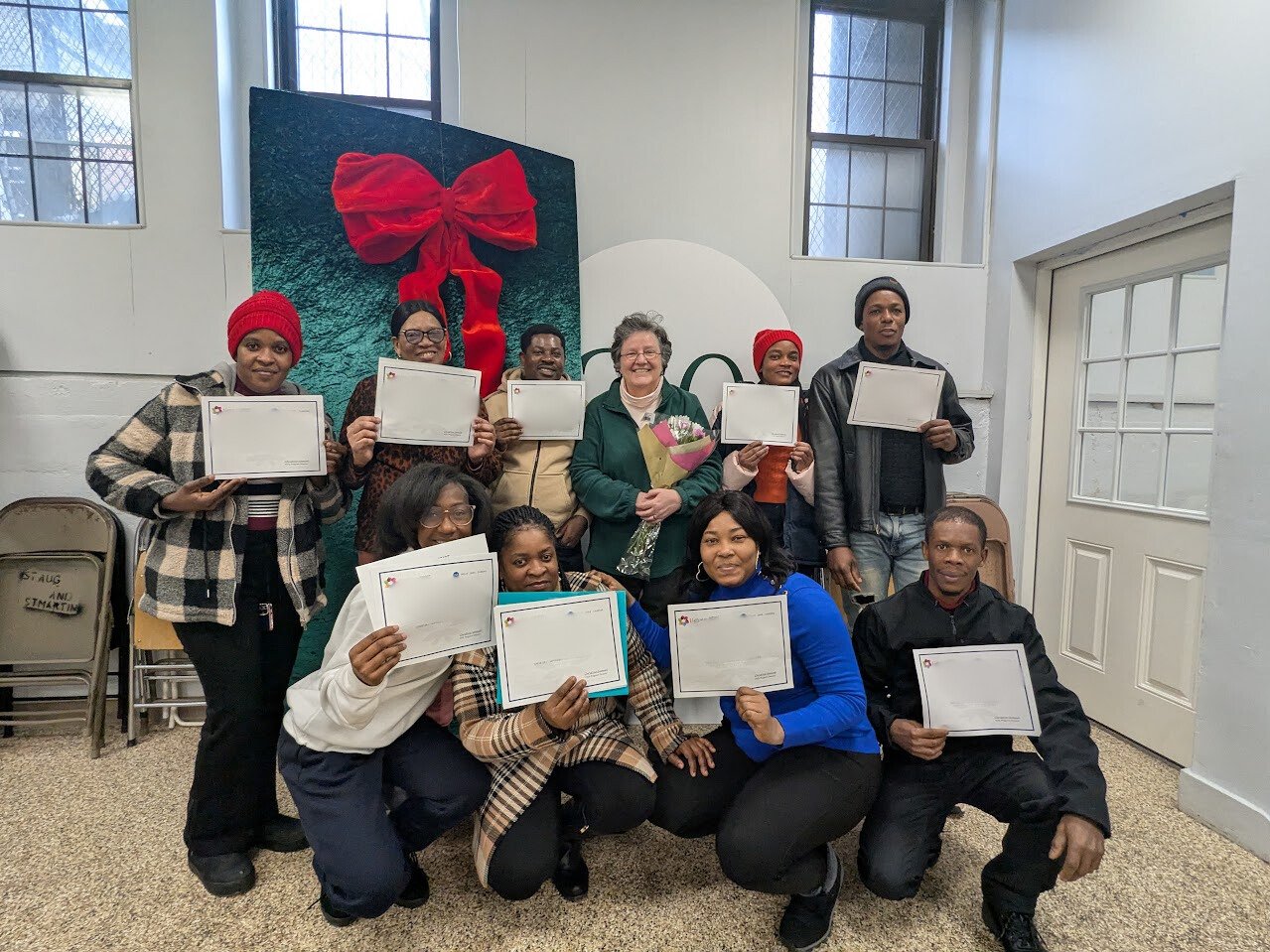
We are thrilled to announce that 58 dedicated students have successfully completed the latest cycle of our English for Speakers of Other Languages (ESOL) program!
We celebrate the achievements of these 58 remarkable students, recognizing their dedication and hard work. Each certificate represents a significant milestone in their journey towards mastering the English language. For those who did not receive a certificate this time, we look forward to their continued participation in future cycles.
Learning English helps create profound and lasting changes in our student’s lives. Our program not only facilitates language learning but also fosters a sense of community and belonging. Students gain the confidence and skills needed to thrive in their new environments, contributing to a more inclusive society.
We are looking for teachers! Your expertise and passion for teaching can help transform lives. By volunteering with A Faith That Does Justice, you become part of a supportive community dedicated to uplifting our students and empowering them through education. Together, we can make a lasting impact on their lives, one lesson at a time.
Contact us at volunteering@faith-justice.org to learn how you can become part of our dedicated team of volunteer teachers.
We are immensely proud of our students and deeply grateful for your interest in supporting our ESOL program. Together, we can create a more just world for all.
We recently had the chance to sit down with Brendan Murphy, Senior Manager of Business Services at Jewish Vocational Service (JVS), who works with A Faith That Does Justice (AFTDJ) on its English for Speakers of Other Languages (ESOL) program. Brendan’s role is to evaluate each student’s English competency to ensure they are placed in the appropriate classes for their skill level. He also ensures that teachers have adequate training and understand the curriculum, and provides overall oversight to the program. Keep reading to learn more about the program and what makes this such a rewarding role for Brendan and the volunteers involved.
What is the process for new students interested in the program?
AFTDJ advertises the cycle openings. Anyone interested can sign up through the AFTDJ website or reach out. There are a lot of entry points to allow them to express their interest. Then one of the student relationship managers (SRM) reaches out to collect basic information about them and talks to them about the classes – when they are, how remote classes work.
I do a formal assessment that measures their English abilities, in listening and speaking, to determine which class is right for them. We usually offer beginner and intermediate class options on Monday and Wednesday evenings and a multilevel class on Tuesday and Thursday mornings. We recently began implementing a threshold for the assessment so that we are only serving beginner and intermediate students since we have a waitlist for the classes. Once we know which class they’ll be in, we inform the teacher who gets them set up on WhatApp and Zoom to begin the course.
You mentioned a waitlist. How does that work?
There is a big demand for ESOL, so most programs have a waitlist. We ideally want to have 15-20 students per class section, and we really try to find the right people for each class – students who are going to attend consistently and who are at the beginning to intermediate level. We have been really working on consistency with the students to make sure they get the most out of the experience and because there are so many people waiting to have this opportunity. Our attendance rates right now are the best they have ever been, so we’re really proud of that.
The teachers are all volunteers, not professional educators – tell us how that works.
It is amazing that everyone is volunteering their time. The teachers put in so much effort. This program is built on a desire to serve others – in action, not just talk. These volunteers are giving hours every week to serve people in need. When someone is volunteering their time for free, you don’t want to ask too much of them. But, at the same time, we want to make sure this is a quality program. The people taking classes want to be successful so we want classes to be top-notch in prep, delivery, etc. That’s our goal – to give the students the best quality classes. We are lucky to have volunteer teachers who share those same goals and give so much to this program.
What is the training like for the teachers?
JVS provides training modules and the class curriculum, so the volunteer teachers have a sequential curriculum to follow. When a new volunteer expresses an interest in teaching, I reach out to learn about their prior experiences and what brings them to this work. Then I set them up with modules developed by JVS about best practices for teaching English to beginners, get them set up in our system so that they access everything they need, and make sure they know about all the resources available to them.
One thing we have really been focusing on this year is internal communications – making sure that SRMs and teachers are getting to know each other so that they can collaborate and learn from each other. We have some teachers who have been doing this for a long time and others who are new so we have started getting together so that everyone can get to know each other and rely on each other. There is really a community forming. It’s cool to see.
Tell us more about the students.
It’s terrible that there are negative stereotypes of people that come to our country because the students are the hardest working people in our country. They have so many things they want to accomplish. Many of them were at a certain level or job in their home country and then they moved here and are starting over.
We have classes where people speak Spanish and Portuguese and Haitian and Arabic and African dialects – and they’re all together and learning from each other. Students feel comfortable being vulnerable, sharing, making mistakes, and trying. That’s how they learn. And they are all so supportive of each other.
Classes become a community themselves. There is such a positive feeling in all the classes. Students really cheer each other on. If someone is struggling, they’ll help and support them. People are mostly new to the US and often are lonely, so this becomes so much more than a class.
Visit our website here to learn how you can get involved with our ESOL program.
 Being a person of faith means more than worship and prayer; it also means putting your faith into action. We believe that to truly honor God’s love and intention for a just world, it is up to us to put his words into action to create a world free from injustice. That is one of the reasons we developed our English for Speakers of Other Languages (ESOL) program. When people arrive here from other countries, seeking better lives for themselves and their children, they are confronted with the hard realities of not only acclimating to a new culture but in communicating in a new language. People from all walks of life cross our borders seeking to bring their talents, ambitions and hard work to achieve the American dream, but without English language skills, they often struggle just to get by.
We have partnered with Jewish Vocational Services (JVS) to develop a 12-week program for non-English speakers with beginner English-language skills. The 12-week program includes 2 classes per week for a total of 48 hours of in-classroom teaching. Research tells us that a person needs 90-100 hours of instruction to advance to the next level of language skill, so we encourage students to complete at least 2 sessions of 12 weeks. Upon completion of the course, JVS offers career counseling and support to help participants put their new language skills to use bettering their lives and reaching their full potential.
Each class is taught by a volunteer teacher who is assisted by 1-2 volunteer tutors to ensure an effective and personalized experience for the students. Class sizes range from 8-12 students who are grouped together based on their skill level to ensure all students are engaged and learning not only from the teachers, but from each other. The lesson plans are developed by JVS with a specific focus on how to communicate the basics in daily life, such as how to make medical appointments and participate in job interviews. In the past year, we have graduated 51 students from the ESOL program.
If you are interested in volunteering or know someone who would like to participate in the program, please reach out to us at esol@faith-justice.org or at (857) 990-3670.